The United States writes the month first, so 03/04/2026 is March 4. The UK and most of Europe write the day first, so the same digits are April 3. To check a file you received, look for a date with a number above 12: 25/12/2026 can only be day first. If a date has to travel between the two, write it as 2026-03-04. That year-first style comes from the international standard ISO 8601 and has one standard reading.
The same date, written in thirteen places
Here is 4 March 2026 as software writes it in each place, with a two-digit day and month and the place’s usual order and separator.
| Place | Order | How it is written |
|---|---|---|
| United States | month first | 03/04/2026 |
| Canada (English) | year first | 2026-03-04 |
| United Kingdom | day first | 04/03/2026 |
| Ireland | day first | 04/03/2026 |
| Australia | day first | 04/03/2026 |
| France | day first | 04/03/2026 |
| Germany | day first | 04.03.2026 |
| Spain | day first | 04/03/2026 |
| Netherlands | day first | 04-03-2026 |
| Poland | day first | 04.03.2026 |
| Sweden | year first | 2026-03-04 |
| Japan | year first | 2026/03/04 |
| South Korea | year first | 2026. 03. 04. |
We made this table ourselves on November 29, 2026. We asked Node.js 26 to write the date for each place, using CLDR version 48, the Unicode locale data that browsers and many programs rely on. The short styles that software offers can differ: the US one drops the leading zeros and the year’s first two digits (3/4/26). People also write dates differently by hand. Canada shows how loose the rule is. The locale data says year first, but all three orders are in daily use there.
Where each order is used
In Wikipedia’s list of date formats by country, day first is the order for most of the countries listed, including the UK, Ireland, Italy, the Netherlands, Brazil and Mexico, and most of Africa, the Middle East and South America.
Month first is mainly the United States, plus US territories and associated states such as American Samoa and the Federated States of Micronesia. The Philippines, the Cayman Islands and Puerto Rico use both day first and month first. Canada uses all three.
Year first is the usual order in China, Japan, South Korea, Hungary, Lithuania, Mongolia and Taiwan.
Wikipedia is written by volunteers, so for a country that matters to your work, check that country’s own standards body as well.
How often a date is really unclear
A date can be read two ways only when both numbers could be a month (both are 12 or below) and the two numbers differ. Count it for 2026, which has 365 days:
- 221 days have a day from 13 to 31. They have one reading only, because 25/12/2026 cannot be month 25.
- 12 days have the same number for day and month, such as 05/05. Both readings agree.
- 132 days can be read both ways. That is 12 months times 12 days, minus the 12 matching ones.
So a single date is unclear about 36 times in 100. A list usually contains a day above 12. If the dates were spread evenly through a year, the chance that none of five dates has a day above 12 is about 1 in 105. For ten dates it is about 1 in 11,000. So if the whole column was written in one order, one date such as 25/12/2026 shows that order for all of it.
Real lists are not spread evenly. A file of invoices that are all dated on the first of the month stays unclear from the first row to the last, however long it is. A list that mixes two orders also defeats the method, so a check of the result is still needed.
A converter can work out the order from the data in the same way: it looks for a number above 12. If it finds none, it should stop and ask instead of guessing. The date format converter on this site works that way. It runs in your browser, so your file is not uploaded.
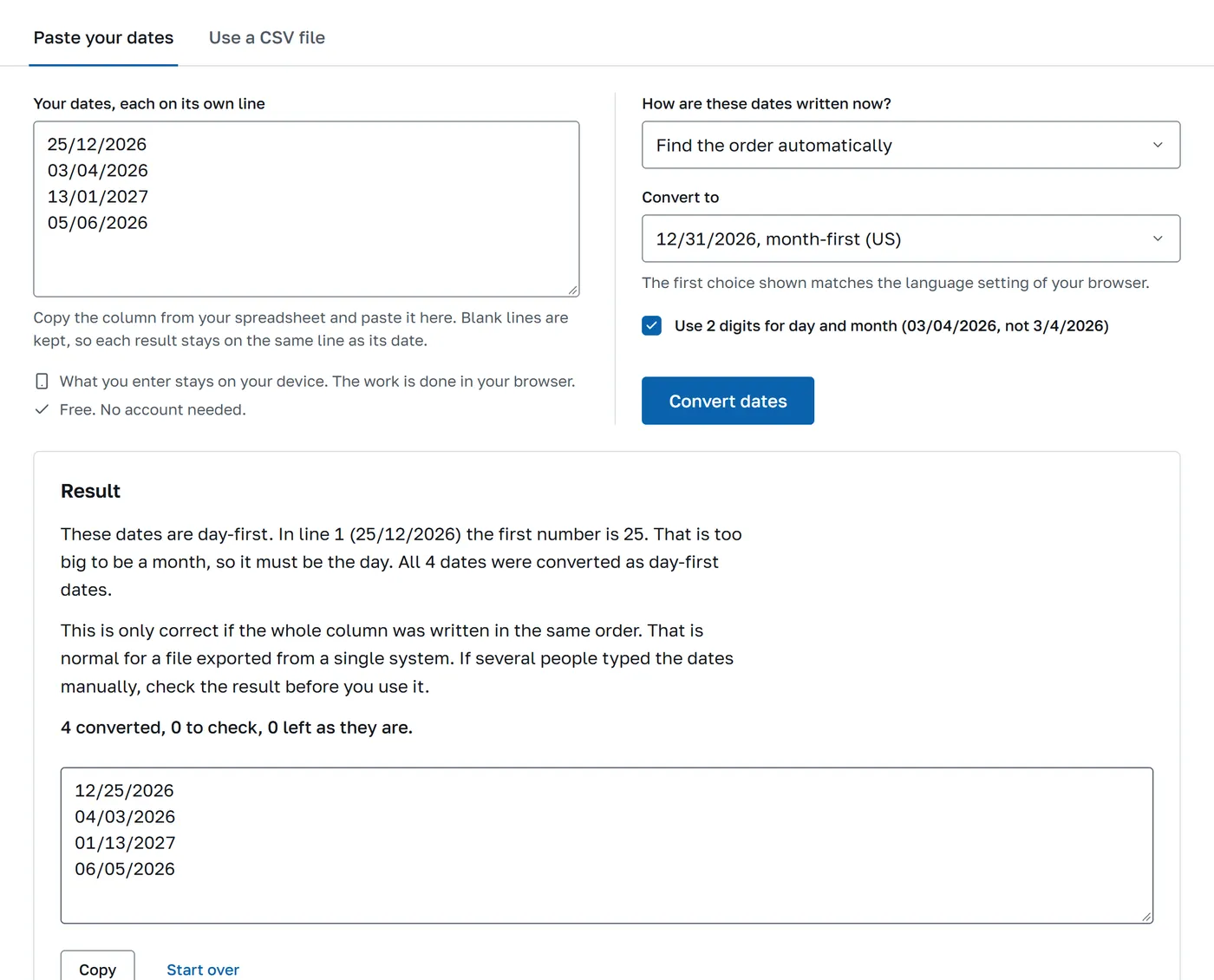
Here are both cases in the converter. In the first, the list has a 25 and a 13 in the day place, so it must be day first, and it is converted:
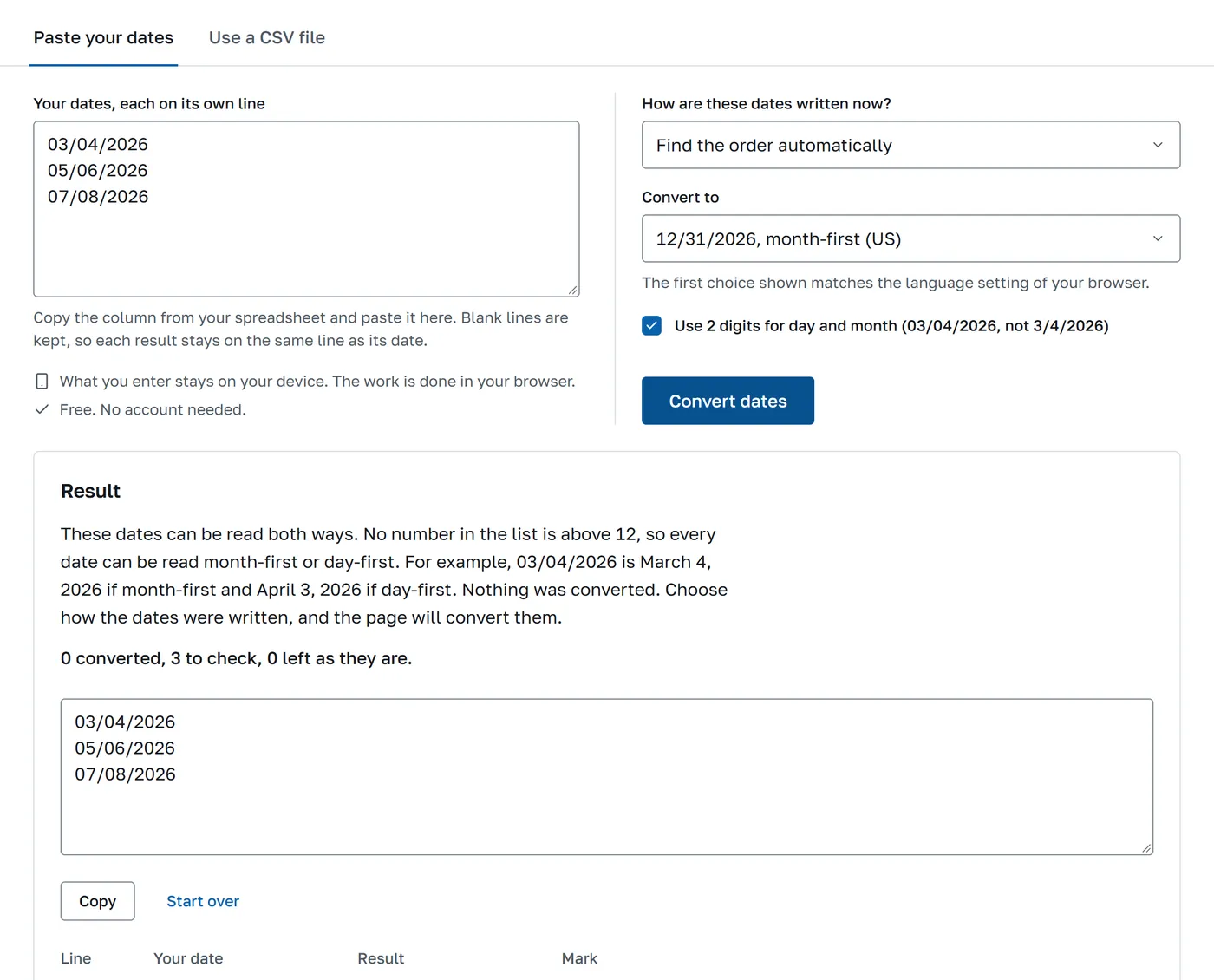
In the second, no number is above 12. The converter converts nothing and asks you to choose:
Which format to use for what
| Situation | Use | Example |
|---|---|---|
| A file or data sent to another country or another program (CSV, import, database) | Year first, ISO 8601 | 2026-03-04 |
| A letter, invoice or web page for readers in one country | That country’s own style, with the month written out if you can | 4 March 2026 or March 4, 2026 |
| A form where people type a date | Show the pattern beside the box | dd/mm/yyyy |
| File names | Year first, so alphabetical order is date order | 2026-03-04-report.pdf |
The file-name case shows why year first works. Sorted as text, day-first names put the newest file in the middle:
- 04-03-2026-report
- 15-01-2027-report
- 20-12-2025-report
Year-first names come out in true date order:
- 2025-12-20-report
- 2026-03-04-report
- 2027-01-15-report
ISO 8601 also covers the time of day and time zones. 2026-03-04T14:30:00Z means 14:30 in UTC. The W3C’s note on date and time formats picks a short list of ISO 8601 styles for web use and insists on four digits for the year.
Where a person reads the date, a written month leaves less room for error. With 4 March 2026 or March 4, 2026, a reader who knows the language cannot swap the day and the month.
We opened a CSV file that held 2026-03-04 in Excel 2024 on a PC with US settings. Excel read it as March 4, 2026, which is what we wanted. It then showed it in its own style, 3/4/2026, while the file stayed year first. We could not test a computer set to a day-first country. The CSV post has the full test.
If your file is already in the wrong order
Say a supplier in the UK sends you a list with 04/03/2026 and your computer reads it as April 3. Paste the column into the date format converter, choose the order you want, and check the marked rows. If you are not sure why your own dates change when someone else opens the file, this post on Short Date and Long Date explains it.
Sources
All pages below were read on November 29, 2026.
- ISO 8601, date and time format, International Organization for Standardization.
- Date and Time Formats, W3C Note (1997).
- List of date formats by country, Wikipedia.
- Unicode CLDR, the locale data behind the table. We read version 48 through Node.js 26.